


When the Michelin Guide’s arrival in the Philippines was first being discussed, I was skeptical about whether we should be spending scarce tourism resources trying to attract it.
The country already had a long list of more pressing priorities: Visa liberalization, international air connectivity, better airports and roads, stronger destination marketing and more meetings, incentives, conferences, and exhibitions (MICE) infrastructure. With finite budgets and limited government attention, why should securing a restaurant guide be a priority?
Raising value
Looking back, I underestimated what it could do. Michelin is not a marketing spend competing with connectivity and infrastructure. It plays a different role, one that raises the value of the visitors already arriving.
The fundamentals have not changed. The Philippines still needs more flights, easier access, better airports and stronger transport infrastructure. But the context in which we need to think about tourism growth is changing.
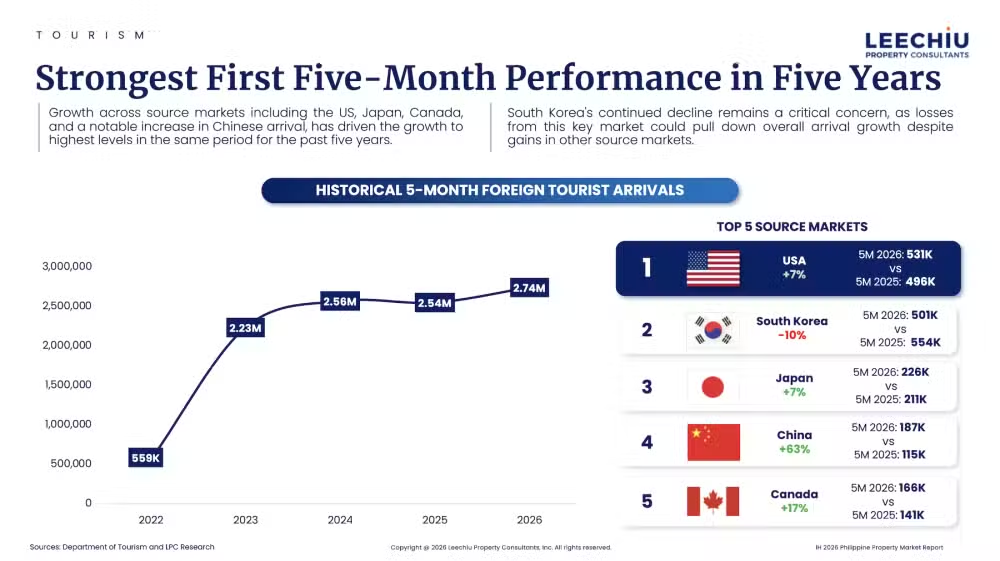
The country welcomed 2.74 million inbound visitors in the first five months of 2026, the strongest five-month start in five years
Yet the pace of growth has been slowing—from 17 percent year-on-year in February to around 1 percent by May, as the international travel environment became more difficult, the Iran crisis disrupted flight schedules and traveler confidence, and competing Asean destinations continued to strengthen their own tourism propositions.
Fundamental challenge
The headline remains encouraging, but it also highlights a more fundamental challenge. The Philippines is competing for the same pool of regional tourism spending as destinations that are becoming increasingly sophisticated at giving travelers reasons to visit, stay longer and spend more.
For years, Philippine tourism has understandably focused on arrivals. More visitors mean more hotel nights, more spending and more jobs, and the country still has considerable room to increase its share of international tourism.
But an arrival is only the beginning of the economic equation. Two visitors can both count as one arrival while making very different contributions depending on how long they stay, what they spend and how widely they travel.
A traveler who stays three nights and one who stays five both appear as a single arrival in the statistics. Economically, however, they are very different visitors. The same is true of someone who spends most of a holiday inside a resort compared with someone who explores the surrounding city, eats at local restaurants, shops and visits attractions.
This is where the development of the Philippine culinary scene becomes relevant. Food is not a niche tourism activity. A stronger dining scene can give travelers another reason to explore a city rather than simply pass through it.
International discoverability
The Michelin Guide provides something particularly useful in this regard: International discoverability.
Travelers who know little about restaurants in Manila or Cebu may already understand what Michelin represents. That gives Philippine restaurants an established platform through which to reach an international audience, rather than requiring the country to build that credibility from scratch.
The real value, however, is not the recognition itself but what it can encourage a traveler to do.
A business traveler attending a three-day conference in Manila may have little reason to remain after the event. If there are enough dining, cultural and leisure experiences to make an additional day attractive, the conference can become a longer trip. The hotel gains another room night, but so do restaurants, transport operators, retailers and attractions.
The same principle applies to leisure travel. Manila can be a gateway to the Philippines or a destination in its own right. Cebu can be a stop on the way to a beach or diving resort or a city where visitors spend several days.
For the hotel and investment sectors, the significance is ultimately about the quality of demand. A destination with more reasons to visit and more experiences to consume is inherently better positioned than one whose appeal is concentrated around a single attraction.
Natural assets
The Philippines already has the natural assets to compete, particularly its beaches, islands and diving, but our Asean competitors are building increasingly sophisticated ecosystems around theirs.
The choice is not between physical infrastructure and destination experiences. They do different jobs: Flights, airports and roads bring visitors here, while food, culture and attractions shape what they do once they arrive.
Michelin is one example of how an internationally recognized platform makes part of that easier to find.
That recognition also carries beyond the businesses that receive it. Tourism spending concentrates around established destinations, but dining can draw visitors into neighborhoods they would otherwise never see.
None of this makes Michelin a tourism strategy. It cannot fix connectivity, improve an airport or make visas easier, and those fundamentals should continue to receive the bulk of attention and investment.
But tourism infrastructure is broader than concrete and steel. Destinations also need the reputation and the experiences that help a traveler decide where to go, and whether a trip is worth extending.
For years, the central question has been how to bring more visitors to the Philippines. As competition for those visitors becomes tougher, we should be asking an equally important question: Once they arrive, what will make them want to stay?
The article was originally published in Inquirer.NET and written by Alfred Lay.
If you like this article, share it on social media by clicking any of the icons below.
About Post Author


More Stories
Camella Honors GenSan Heritage and Homegrown Spirit at Tuna Festival 2026
Gabriel Formoso named National Artist for Architecture
Makati: The city that is learning to walk again