


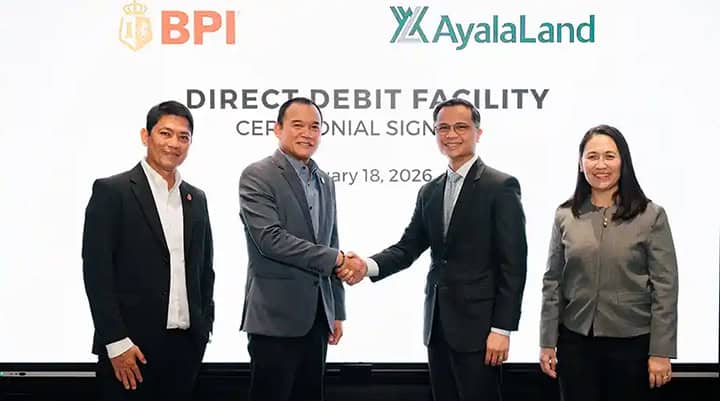
The Bank of the Philippine Islands (BPI) and Ayala Land Inc. (ALI) recently announced they are among the early adopters of the Direct Debit facility in the Philippines, an interoperable and multilateral auto-debit system that allows property buyers and tenants to settle recurring payments from any account from participating banks—seamlessly, securely, and on schedule.
Louie Cruz, head of BPI institutional banking tells the BusinessMirror in an email interview that the Direct Debit facility is a product of strategic collaboration between two leading Ayala companies, combining BPI’s digital banking infrastructure and Ayala Land’s extensive property ecosystem to modernize payment processes and elevate the overall customer experience. Through the integration, ALI property buyers and tenants can authorize automatic debits from any participating banks for recurring obligations such as property amortizations, rentals, association dues, and other scheduled payments, with full rollout targeted within the first quarter of the year following the pilot phase.
“The Ayala Land-BPI Direct Debit facility represents a major step forward in fixing the long‑standing fragmentation of auto‑debit arrangements in the country. We are proud to be among the early adopters of this system. For years, customers could only automate payments if they and their biller were in the same bank,” Cruz explains.
With the support of the Philippine Clearing House Corporation (PCHC), Philippine Payments Management, Inc. (PPMI), and the Bangko Sentral ng Pilipinas (BSP), Cruz says that BPI and ALI are removing the barrier through an interoperable system enabled by the BSP and backed by secure clearing processes, giving homebuyers the freedom to automate their amortizations using any participating bank. Cruz considers a game changer for property owners who can now enjoy seamless, on‑time payments without the stress of monthly reminders or manual transactions.
The ALI-BPI Direct Debit facility represents a major step forward in fixing the long‑standing fragmentation of auto‑debit arrangements in the country. We are proud to be among the early adopters of this system. For years, customers could only automate payments if they and their biller were in the same bank.
“With the support of the Philippine Clearing House Corporation [PCHC], Philippine Payments Management, Inc. [PPMI], and the Bangko Sentral ng Pilipinas [BSP], we are removing this barrier through an interoperable system enabled by the BSP and backed by secure clearing processes, giving homebuyers the freedom to automate their amortizations using any participating bank. This shift is actually a game changer for property owners who can now enjoy seamless, on‑time payments without the stress of monthly reminders or manual transactions,” Cruz explains.
For ALI, Cruz says the move from traditional collection facilities to an electronic collection facility that enables same‑day settlement and standardized reporting significantly strengthens the operational efficiency. It provides real-time cash visibility, simplifies the reconciliation process and allows to automate its processes, which minimizes manual processing errors. With this setup, this enables the team to focus on delivering greater value to communities. For BPI, Cruz it reaffirms the bank’s commitment to building secure, interoperable, and future‑ready digital payment rails.
As one of the early adopters of the interoperable direct debit in the Philippine property sector, the BPI-ALI collaboration brings to life the very vision the BSP has set for the country—a payments ecosystem where convenience, interoperability, and efficiency are the norm.
By operationalizing BSP’s first multilateral auto‑debit scheme in a long‑tenor, high‑value industry like real estate, we are showing how regulated interoperability can meaningfully transform how Filipinos meet their financial obligations.
Cruz describes the partnership as setting a new standard for cross‑industry collaboration by demonstrating what becomes possible when private institutions align with BSP’s roadmap for a more inclusive and digitally empowered economy.
Through this first-in-the-country platform, Cruz says BPI and ALI are setting a new benchmark for digital payments in the Philippine property sector, demonstrating how cross-industry collaboration can modernize financial infrastructure while creating tangible value for customers and businesses nationwide.
“We believe this will encourage more property developers, banks, and billers to adopt interoperable payment streams, accelerating the shift toward a nationwide digital payments infrastructure that is faster, more secure, and centered on the needs of the Filipinos,” Cruz says.
The article was originally published in Business Mirror and written by Rizal Raoul S. Reyes.
If you like this article, share it on social media by clicking any of the icons below.
About Post Author





More Stories
Pricing right, winning the fight: PHL property valuation in 2026
Find your way to the east: The real estate landscape of Rizal Properties
Great ideas don’t grow old: Understanding new urbanism