

As sustainability moves higher on the agenda of developers and builders, the search for materials that can help reduce the environmental impact of construction continues to intensify. Among the options available, one resource long associated with rural architecture and traditional craftsmanship is emerging as a serious contender for modern development: bamboo.
Despite being recognized as one of the world’s most renewable building materials, bamboo remains largely absent from the country’s growing urban landscape. This is despite qualities that make it particularly relevant to today’s climate and construction challenges. Unlike conventional timber, which can take decades to mature, structural bamboo can be harvested within three to five years, regenerates naturally without replanting, and absorbs carbon throughout its growth cycle.
Its potential is especially significant at a time when the construction sector is under increasing pressure to lower emissions. According to the Global Status Report for Buildings and Construction 2024-2025, the industry accounts for approximately 37% of global energy- and process-related CO2 emissions, making the transition to lower-carbon building solutions an urgent priority.
For Base Bahay Foundation, Inc. (BASE), a Philippine-based non-profit initiated by the Hilti Foundation, the challenge has never been about the capability of bamboo itself. Instead, the issue lies in the absence of systems needed to support its widespread use.
“We have been asking bamboo to perform inside a construction system that was never designed to support it,” says BASE General Manager Engr. Luis Felipe Lopez.
Recognizing this gap, BASE has focused on developing an ecosystem that can help position bamboo as a viable material for mainstream real estate and infrastructure projects.
One area of focus is engineering reliability. Bamboo has often faced skepticism because its characteristics can vary depending on species, age, cultivation conditions, and treatment processes. These variables have historically limited confidence among engineers, contractors, and regulators considering the material for structural applications.
To address these concerns, BASE has developed and validated several bamboo-based technologies designed to meet the demands of modern construction. Among these is Cement-Bamboo Frame Technology (CBFT), alongside bamboo building components, prefabricated systems, and other engineered solutions.
The organization has established standardized procedures covering material selection, treatment, testing, and engineering design to ensure consistent and measurable performance. Through ongoing research and implementation, BASE has demonstrated how bamboo can be incorporated into contemporary building systems while responding to industry requirements.
Beyond technology development, the organization has also contributed to the advancement of standards, testing methods, and regulatory frameworks that support broader industry adoption. These efforts aim to provide the technical foundation necessary for bamboo-based systems to be certified, insured, and deployed on a larger scale.
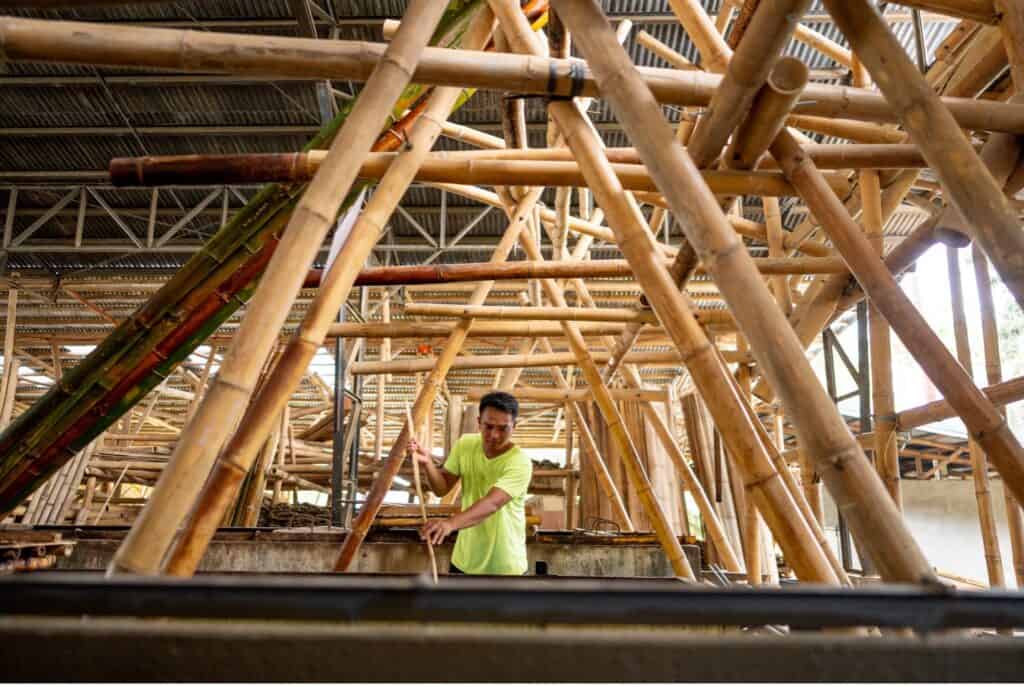
Equally important is the development of a dependable supply chain.
For construction materials to gain acceptance among developers, availability and consistency are critical. BASE works with global enterprises to strengthen infrastructure for harvesting, treatment, and prefabrication, helping establish a traceable supply network capable of delivering bamboo at the quality and volume required for construction projects. The approach seeks to transform bamboo from an agricultural commodity into a standardized building material.
The foundation is also investing in workforce development through its Bamboo Academy. Since bamboo behaves differently from conventional materials such as steel and concrete, specialized knowledge is required for design and construction.
Through the academy, architects, engineers, and builders receive training in bamboo processing, advanced architectural and structural design, and connection detailing, helping expand the pool of professionals equipped to work with bamboo-based systems.
The market conditions for wider adoption continue to evolve. As developers respond to Environmental, Social, and Governance (ESG) requirements and seek ways to reduce embodied carbon—the emissions associated with producing and transporting building materials—bamboo is gaining attention as a potential alternative.
The global bamboo industry was valued at more than USD 72 billion in 2019, highlighting the scale of the resource and the opportunities available if greater integration into the property sector can be achieved.
“We are not just promoting a material; we are engineering an ecosystem,” says Luis Lopez. “The opportunity extends far beyond construction. Bamboo can drive climate action, rural development, job generation, and sustainable industry. Our goal is to build an ecosystem where bamboo’s environmental, social, and economic value can be fully realized. When that happens, adoption will follow naturally.”
As demand grows for the next generation of green building solutions, BASE believes bamboo is increasingly aligned with the evolving needs of the real estate industry. The projects and structures supported by the organization demonstrate its potential, while broader adoption now depends on the willingness of developers, policymakers, and builders to integrate bamboo into future projects.
For more information on Base Bahay Foundation, Inc. and its projects, visit www.base-builds.com.
The article was originally published in PhilStar Property.
If you like this article, share it on social media by clicking any of the icons below.
About Post Author


More Stories
Camella Honors GenSan Heritage and Homegrown Spirit at Tuna Festival 2026
Gabriel Formoso named National Artist for Architecture
Makati: The city that is learning to walk again