



Five years of data center talk, and we are now back to this—semiconductors.
It has become the defining strategic commodity of this decade, and governments are racing to secure their place in a supply chain concentrated in East Asia.
Two initiatives on opposite sides of that supply chain—one American-led and touching Philippine soil directly; The other, a case study in Japan and already years into execution—show what this race looks like at different stages, and what it could mean for our property market.
Pax Silica: a coalition, not just a policy
By now, there is enough information about what Pax Silica is, and the recent Luzon Economic Corridor Investment Forum concluded with high hopes for attendees.
With the recent launch of the Philippine Artificial Intelligence Infrastructure Master Plan (PAIIM) 2026-2033, the key corridors within the country have now expanded, including Calabarzon Region supporting hubs and more.
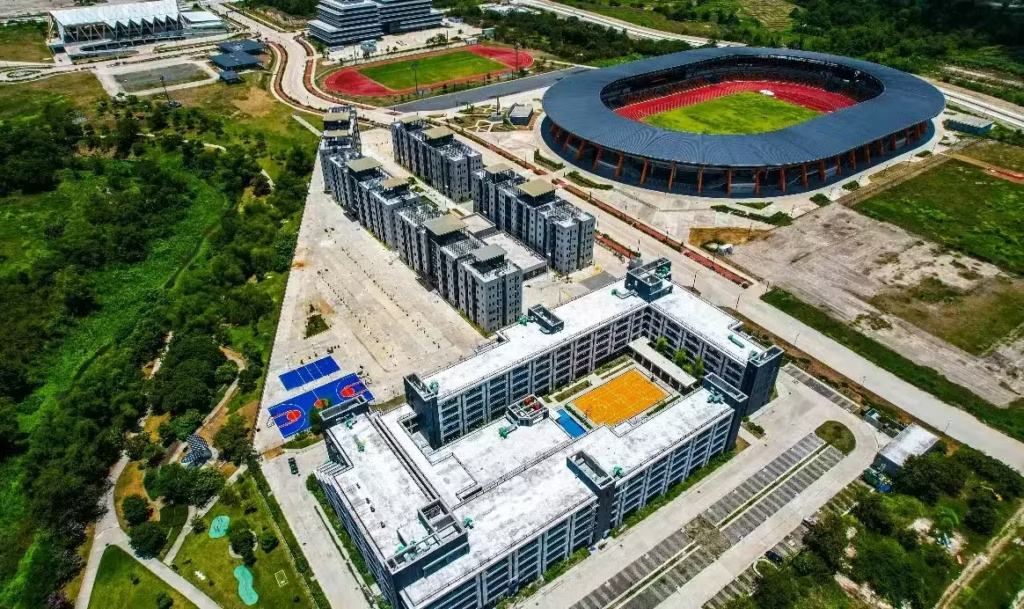
For the Philippines, Pax Silica is not an abstraction. It is materializing as a 1,619-hectare hub designated a “Golden Node,” or what I call the main catalyst, on the land of the Bases Conversion and Development Authority (BCDA) in New Clark City, Tarlac, within the Luzon Economic Corridor.
This is the catalyst that real estate investors have been waiting for.
The scale is enormous: the project needs roughly 130 million liters of water daily and 3 gigawatts of power—about 16 percent of Luzon’s grid capacity, comparable to 600,000 households’ consumption. A hub this size does not simply create floor space—it reorders demand for power, logistics land, and worker housing across the corridor.
Japan: the strategy that got there first
Japan is the closer-to-home comparator, having run this playbook longer.
In 2021, Japan’s Ministry of Economy, Trade and Industry (METI) issued its Strategy for Semiconductors and the Digital Industry, aimed at reversing a decline that had taken the country’s global chip market share from roughly 50 percent in 1990 to about 10 percent today.
Tokyo revised the strategy in 2023 and again in 2024, tripling its 2030 sales target for domestic chipmakers to more than 15 trillion Yen (about $108 billion) and directing subsidies toward advanced fabrication, materials, and equipment.
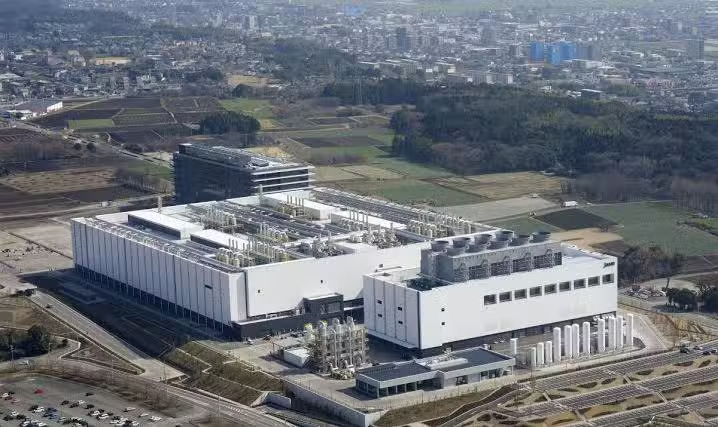
Its centerpiece is Kumamoto Prefecture in Kyushu, where Japan Advanced Semiconductor Manufacturing, TSMC’s local joint venture with Sony Semiconductor Solutions, Denso and Toyota, brought a multibillion-dollar fab into production in December 2024. Its economic impact on the electronics sector is projected at roughly $45.6 billion over 10 years.
What JLL’s own data shows
This is not a hypothetical pattern. JLL’s own research has tracked it on two continents.
JLL Research’s 2024 study of the U.S. CHIPS Act build-out found government incentives for fab construction were reshaping American industrial real estate—drawing manufacturers and adjacent industries into new “semiconductor ecosystems” around fab sites, with corporate real estate central to site selection and leasing.
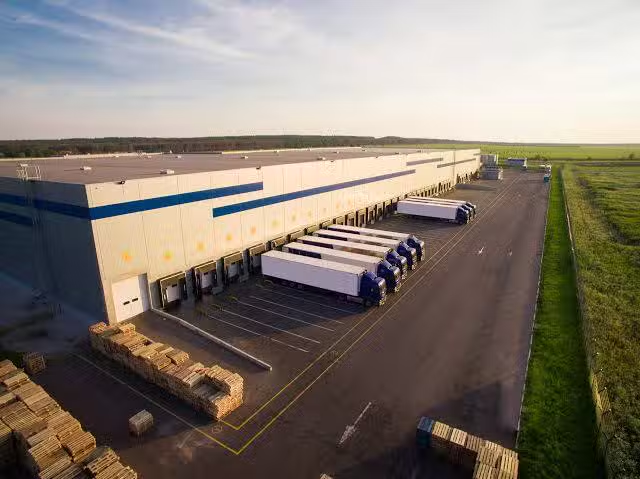
In Kumamoto, JLL’s research on Japan’s rental apartment market documents how semiconductor-related corporate bases directly drove up housing construction in a previously unremarkable regional market–one of only two prefectures nationwide where rental starts rose against a declining national trend.
Land prices near the plant have risen sharply since it broke ground, a pattern specialists now describe as a template for how fabrication investment cascades into logistics, supplier facilities and residential demand.
New Clark City’s planners and investors will need to underwrite this cascade, not just the fab itself.
Two stages of the same story
The contrast is less about different strategies than different points on the same timeline.
Kumamoto shows what a semiconductor hub looks like once it is delivering: rising land values, tight rental housing, and a supplier ecosystem grown up around one anchor investor over several years. New Clark City is still where Kumamoto was five years ago, with the framework being negotiated and infrastructure yet to catch up with the ambition.
For the Philippines, the opportunity is real but conditional.
Pax Silica situates the country inside a coalition it did not design, at a site whose success hinges on infrastructure constraints that dwarf typical industrial park planning.
If water and power questions are resolved with the urgency that geopolitics demands, the Luzon corridor could follow Kumamoto’s trajectory–and become one of the decade’s more consequential industrial property stories for logistics operators, office and housing developers and utility investors along Clark–Subic–NLEX, not just for chipmakers.
Japan’s experience is the clearest evidence yet of what that trajectory can deliver and how much groundwork it takes to get there.
The article was originally published in Inquirer.Net and written by Joey Radovan.
If you like this article, share it on social media by clicking any of the icons below.
About Post Author





More Stories
Gabriel Formoso named National Artist for Architecture
Makati: The city that is learning to walk again
Arthaland trims preferred share offering to P2.5 billion