
I believe that one of the major reasons why the “United States of Makati” is trending on social media is because, for decades, Makati has been operating like a city-state. The central business district (CBD) has high-quality, premium, and sustainable office buildings; ultra-luxury residential towers catering to the discerning demand of affluent buyers; and experiential malls that feature a gamut of local and foreign brands.
Colliers Philippines data show that Makati CBD continues to attract strong demand from multinational office occupants, foreign employees, and, of course, young urban Filipino professionals.
We believe that Makati CBD has a higher cost of living than most areas in Metro Manila because the business district attracts high-income professionals, multinational companies, and investors. This strong demand increases the prices of housing, including condominiums and ultra-luxury landed homes, as well as lease rates of office spaces and commercial establishments.
Rising property values
Property values and rental rates are also significantly higher compared to other submarkets due to limited supply of developable land. Colliers data show that as of Q2 2026, Makati CBD recorded the highest land values in Metro Manila, averaging PHP1.0 million per square meter.
The concentration of premium residential developments, malls, schools, and healthcare facilities also contributes to the area’s higher cost of living and elevated land values.
Strong demand supports property values
Data from Colliers Philippines show that as of Q2 2026, average rents for one- to three-bedroom units in Makati CBD ranged from PHP840 to PHP1,000 per square meter.
Meanwhile, average secondary market prices ranged from PHP 248,000 to PHP 309,000 per square meter.
In the pre-selling market, average condominium prices in Makati CBD reached PHP500,000 per square meter as of Q2 2026. Projects along Ayala Avenue, Makati Avenue, and Legazpi Village command the highest prices, ranging from PHP526,000 to PHP885,000 per square meter.
Thriving office and residential hub
Despite a challenging condominium leasing market in Metro Manila, Makati CBD remains a popular location among expatriates. These foreign professionals value exclusivity and connectivity, making the CBD highly attractive due to its concentration of office towers, high-end condominium units with larger floor areas, upscale malls, and institutional facilities such as international schools and hospitals.
Aside from expatriates, condominium units in the area also attract high-level executives, entrepreneurs, young professionals, and investors seeking premium locations. Buyers and lessees are typically drawn to the developments’ proximity to workplaces, schools, and lifestyle destinations, as well as to their high-quality amenities. Key considerations among prospective buyers and lessees include project amenities, unit sizes, and property management services.
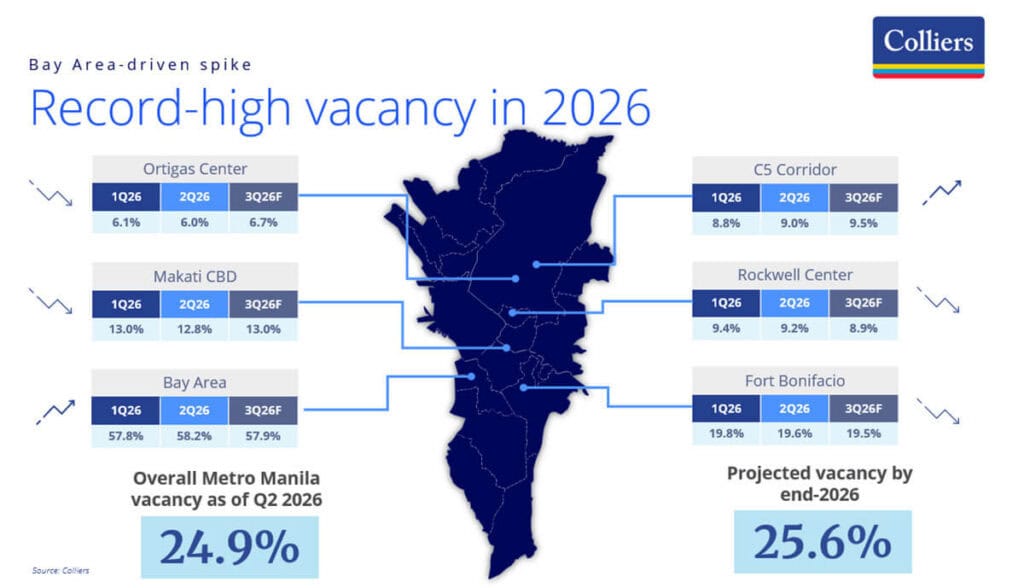
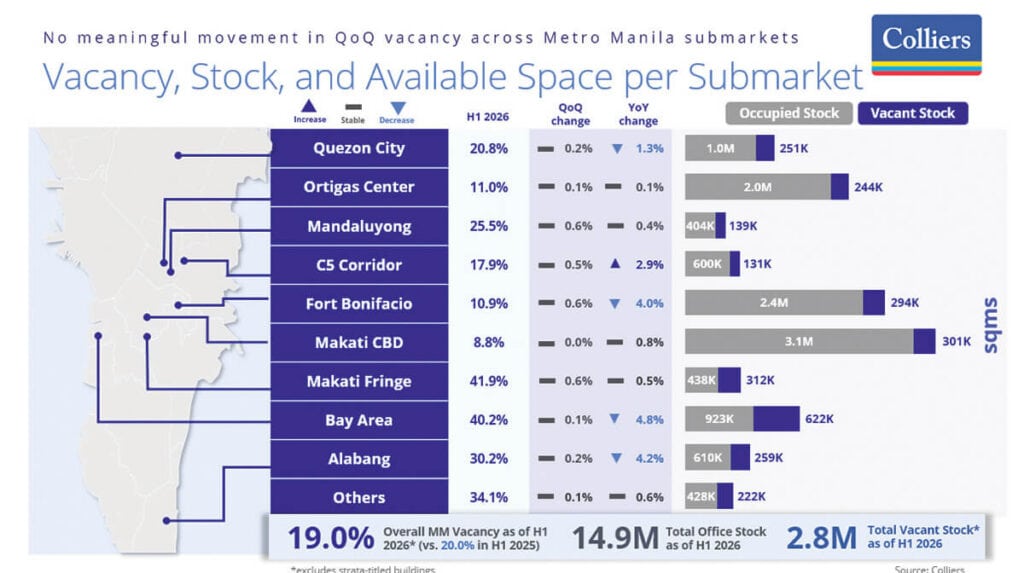
Furthermore, despite higher lease rates for office, residential, and retail, Makati CBD also enjoys the lowest vacancy rates in Metro Manila, indicating strong demand and absorption. Makati CBD accounted for a mere 0.1% of unsold ready-for-occupancy (RFO) condominium units in Metro Manila as of Q2 2026.
Residential vacancy in Makati CBD’s secondary condominium market is significantly lower than the Metro Manila average. As of Q2 2026, the CBD’s secondary residential market vacancy rate stood at 12.8%, less than half of the Metro Manila average of 25%.
Makati CBD’s future-proofed viability as a premium residential enclave
Buyers and investors gravitate toward Makati CBD because this business hub offers unique residential units that feature larger unit cuts, hotel-like amenities and services, resort-style pools, and high-quality finishes. The business district also features high-end malls that house popular local and international brands.
The convenience and accessibility offered by transit-oriented developments also align with young professionals’ desire for a live-work-play lifestyle. They are often willing to pay a premium to reduce commuting time and gain easier access to workplaces, malls, and other services. For many, the premium is not just for the property itself but also for the time savings and improved quality of life that come with living in a CBD like Makati.
Overall, Makati CBD remains popular among young urban Filipino professionals due to its integrated live-work-play shop environment. Developers continue to differentiate and offer curated experiences so that they can stand out amid lingering ‘oversupply’ issues across Metro Manila. Moving forward, we expect Makati CBD to continue capturing demand from multinational corporations (MNCs), shared service firms, large Filipino firms, and embassies. Ultimately, this should strengthen take-up for high-quality offices, premium residential units, and experiential retail spaces in Makati CBD.
The article was originally published in PhilStar Property and written by Joey Bondoc.
If you like this article, share it on social media by clicking any of the icons below.
About Post Author



More Stories
Pillars of Growth: The Value Drivers of the Vista Commercial Assets
Homebuilders group raises concerns over escrow rules
Common Ground targets startups in new ‘digital park’ coworking space