


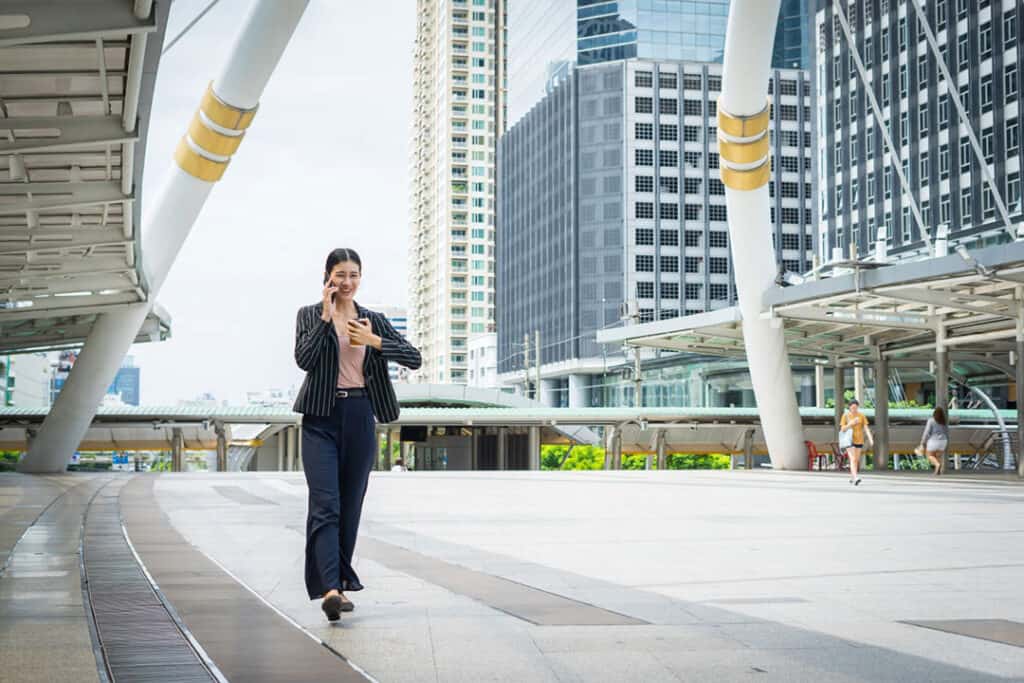
Cities are supposed to be engines of prosperity and progress. Yet, when we look at the Filipino workforce, it is haggard and downtrodden from having to endure grueling commutes, spending as much as two to four hours in transit every day.
Active transport, such as walking, cycling, and public transit, is a vital solution in addressing urban congestion, which the majority already use. However, the lack of end-of-trip (EoT) facilities acts as a barrier that prevents more people from choosing it over private cars.
If we are serious about addressing traffic congestion in our cities, we cannot afford to neglect EoT facilities in our workspaces.
What are EoT facilities?
EoT facilities are amenities in a building that support active transport users. These include racks where people can securely park their bicycles, lockers where personal belongings can be stored, and bathrooms where people can shower and change clothes.
They are important in a tropical country like the Philippines, where more households own bicycles than cars, and more people depend on public transportation than private vehicles.
Sweating is our body’s natural response to the heat and humidity. Meanwhile, the rainy weather in the wet season poses a challenge for anyone under the sun. The effects are even worse with the absence of shaded or covered pathways in our cities.
THE STATE OF OUR EOT FACILITIES
EoT facilities are crucial because they act as the intermediate space between the street and the workspace, where the commuter transitions into a professional office worker. That is why accessibility, convenience, and comfort are essential, not optional.
The problem in Metro Manila is that we often treat these as the back room. Bicycle parking is usually nonexistent and, when present, is usually located in some dark corner at the edge of basement parking. Comfort rooms tend to look like a sewer more than a facility for hygiene.
You know something is wrong when clean and accessible bathrooms are a rarity, even in commercial establishments such as restaurants and malls. There is also a misconception that shower rooms only benefit cyclists, as if people who walk, drive, or ride public transit don’t ever get sweaty or drenched in rain. Everyone is a pedestrian at the start and end of their trip, which is why EoT facilities benefit all kinds of people.
ADVANTAGES OF EOT FACILITIES
The advantages of EoT facilities are cross-cutting. Being in the office doesn’t have to feel exhausting if employees can take a refreshing shower after a grueling commute or a morning jog. This lets them start the day energized and in tip-top shape. Providing lockers, or some form of in-office storage, lets them pack smarter and lighter for their daily trips.
Every employee who switches from a private car to active transport saves time and money, decongests the road, and reduces their carbon footprint. And less parking space would be needed — a parking slot for one car could easily fit anywhere from six to 15 bicycles.
EoT facilities can also function as corporate social responsibility, communicating to others and potential applicants that your company cares about sustainability and employee wellness. They are also important components for green building certification, such as Leadership in Energy and Environmental Design (LEED) by the US Green Building Council and Building for Ecologically Responsive Design Excellence (BERDE) by the Philippine Green Building Council.
EOT FACILITIES ARE CRUCIAL FOR FUTURE 15-MINUTE CITIES
As more Filipinos migrate to urban environments, we will need to create new cities that are smart, resilient, and sustainable. Carlos Moreno introduced the 15-minute city, where all essential amenities, such as your workplace, the grocery, laundromat, restaurants and shops, and local government buildings, should be accessible within a 15-minute trip by walking, cycling, public transit, or any mix of these three.
The world’s largest bicycle garage is located in Utrecht Central Station, where thousands of Dutch commuters park their bicycles before riding the bus, train, or tram. The facility spans over 17,000 square meters and is capable of storing up to 12,500 bicycles, complete with a service area and repair shop.
Funan Center in Singapore was once a shopping mall until it was demolished in 2016 and transformed into a mixed-use development with retail, office spaces, and apartments that is connected to a nearby mass rapid transit (MRT) station via an underpass.
When it reopened in 2019, one of the highlights was its comprehensive EoT facilities. It currently has a bicycle hub with a total of 154 parking slots, five shower stalls, six lockers, and a repair station.
The Philippines still has a long way to go, but there are some examples worth mentioning. Power Plant Mall in Rockwell Center has two locations for bicycle parking. Visitors can park their bicycles or personal mobility devices by the U-racks along Lopez Drive for direct access to the mall entrance. However, there is also the option of basement parking, which is helpful in case of rainy weather.
Metropolitan Manila Development Authority (MMDA) General Manager Gen. Nicolas Torre III is a vocal advocate for active transportation. Wanting to lead by example, he introduced EoT facilities at the MMDA’s motorcycle riding academy in Pasig so that commuters working in the Ortigas central business district have a place where they can shower before reporting to the office.
EOT FACILITIES ARE THE MISSING LINK FOR SUSTAINABLE MOBILITY
It is tragic that there are some who still choose to drive when their destination could easily be reached by more efficient means, especially those traveling short distances within central business districts (CBDs) such as Makati and Bonifacio Global City (BGC). As we continue advocating for sustainable mobility, we must not forget that EoT facilities serve as the connecting link for commuters.
We would like to live in cities that are walkable, bikeable, accessible, well-lit, clean, and convenient. EoT facilities are crucial for productive cities because they improve the mobility and wellness of employees by enticing them to switch to active transportation. And this will benefit everyone with reduced traffic congestion, cleaner air, and a healthier population.
Architect Felino “Jun” Palafox, Jr. is the founder of Palafox Associates and Palafox Architecture Group, Inc. With 53 years of experience in architecture and 51 years in urban and regional planning, he has led more than 2,000 projects in 41 countries. He studied at Christ the King Seminary, the University of Santo Tomas, the University of the Philippines, and Harvard University. His achievements have earned him more than 200 awards, including the United Architects of the Philippines (UAP) Dubai Chapter’s First Lifetime Achievement Award in 2023.
The article was originally published in Business World and written by Felino Palafox, Jr..
If you like this article, share it on social media by clicking any of the icons below.
About Post Author


More Stories
Camella Honors GenSan Heritage and Homegrown Spirit at Tuna Festival 2026
Gabriel Formoso named National Artist for Architecture
Makati: The city that is learning to walk again