

HOUSING PERMIT processing time could be reduced by as much as 50% under the government’s streamlined approval system, according to the Department of Human Settlements and Urban Development (DHSUD), as regulators seek to ease bottlenecks that have constrained new residential supply.
“Once implemented, the total processing time will actually be reduced by as much as 50%,” DHSUD Senior Undersecretary Henry L. Yap said during the department’s 2027 budget deliberations before the House Committee on Appropriations on Aug. 25.
The government earlier streamlined documentary requirements for housing projects under Joint Memorandum Circular No. 1, Series of 2026, signed by 15 government agencies.
Under the guidelines, documentary requirements for subdivision projects were reduced by 72.2% to 62 from 223, while those for condominium projects fell by 56.2% to 71 from 162.
The circular established the electronic Housing One-Stop Processing Center, which is intended to unify and digitalize permitting requirements across agencies involved in housing development.
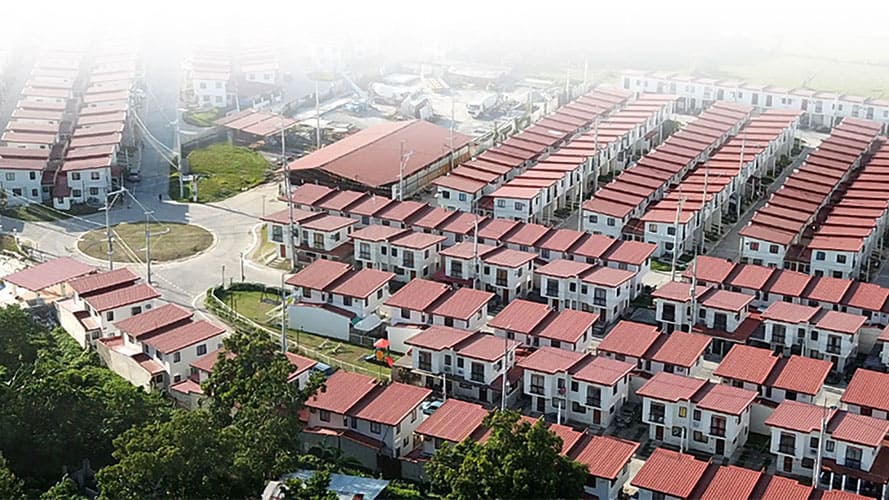
The reforms come as property developers expand their residential footprint outside Metro Manila, where demand for horizontal housing remains resilient.
Colliers Philippines said in its second-quarter property market report that developers are increasingly shifting their attention to provincial markets, where take-up remains strong across horizontal and vertical residential projects.
Average take-up rates for house-and-lot projects in key provincial markets ranged from 88% to 96%, while condominium projects posted take-up rates of 82% to 91%, according to Colliers.
The property consultancy said faster housing approvals and continued decentralization could support residential market growth and allow developers to bring new supply to the market more quickly.
Among developers expanding their horizontal housing portfolio is Megawide Construction Corp. through its real estate arm PH1 World Developers, Inc., which has been pursuing socialized and affordable housing projects outside Metro Manila.
PH1 World Developers has earmarked P1 billion for its five-hectare Southscapes development in Trece Martires, Cavite, which will have 343 horizontal residential units.
Megawide has also signed an initial agreement with the Home Development Mutual Fund, or Pag-IBIG Fund, for the construction of 7,000 socialized housing units under the Expanded Pambansang Pabahay para sa Pilipino, or Expanded 4PH, Program.
DMCI Homes, Inc., the property development arm of Consunji-led DMCI Holdings, Inc., is also preparing the first phase of a 4,000-unit horizontal socialized housing development in Cavite as part of its compliance with balanced housing requirements.
The units will each have a floor area of 27 square meters and will be priced at about P1.8 million. DMCI Homes is also planning a similar horizontal development in Valenzuela City.
Meanwhile, Ayala Land, Inc.’s socialized housing unit BellaVita Land Corp. recently turned over 110 completed houses in Barangay Pacol, Naga City.
The units form part of a planned 1,011-unit horizontal residential development intended for government employees.
DHSUD has separately decentralized the processing, evaluation, and approval of subdivision and condominium regulatory applications under Department Circular No. 2026-012, allowing its regional offices to directly process applications.
The department has also reported consecutive weeks without overdue regulatory applications as it moves to process applications within the prescribed 15-day period.
DHSUD has eased some regulatory requirements involving temporary licenses to sell and compliance with the Balanced Housing Development Program, allowing developers additional time to complete specified requirements while projects move through the approval process.
DHSUD Secretary Jose Ramon P. Aliling earlier welcomed increased private-sector participation in the government’s housing program.
He said private-sector housing production would remain necessary in addressing the country’s housing shortage.
“We do not expect these numbers, the 1.13 million, to address the 3.7 million backlog by 2028 because [the] private sector production is included to address the backlog,” Mr. Aliling said.
The article was originally published in Business World and written by Juliana Chloe A. Gonzales.
If you like this article, share it on social media by clicking any of the icons below.
About Post Author



More Stories
Camella Honors GenSan Heritage and Homegrown Spirit at Tuna Festival 2026
Gabriel Formoso named National Artist for Architecture
Makati: The city that is learning to walk again