

CamSur Uptown officially launched on Aug. 28, with the event hosted by the local government of Camarines Sur. Opening the evening’s ceremonies, Governor Luis Villafuerte Jr. gave attendees a glimpse of what is to come.
The ambitious 250-hectare masterplanned township is situated near Naga Airport, along the central Bicol transport corridor. Plans include a digital campus, Philippine Economic Zone Authority (Peza)-eligible economic zones, mixed-use commercial buildings, a mall, hotels, resorts and a hospital.
The Provincial Capitol Building, already under construction, will anchor the development as its administrative nerve center.
Rooted in local heritage, the building’s architecture draws inspiration from the world-renowned pili nut, blending regional identity with the estate’s forward-looking vision.
While Pax Silica is positioned to transform Central Luzon into a major AI hub, the Camarines Sur provincial government is pursuing its own version of that playbook: A masterplanned estate designed to put the region on the business and technology map.
Timing is critical
Office demand in provincial markets is not having an easy year.
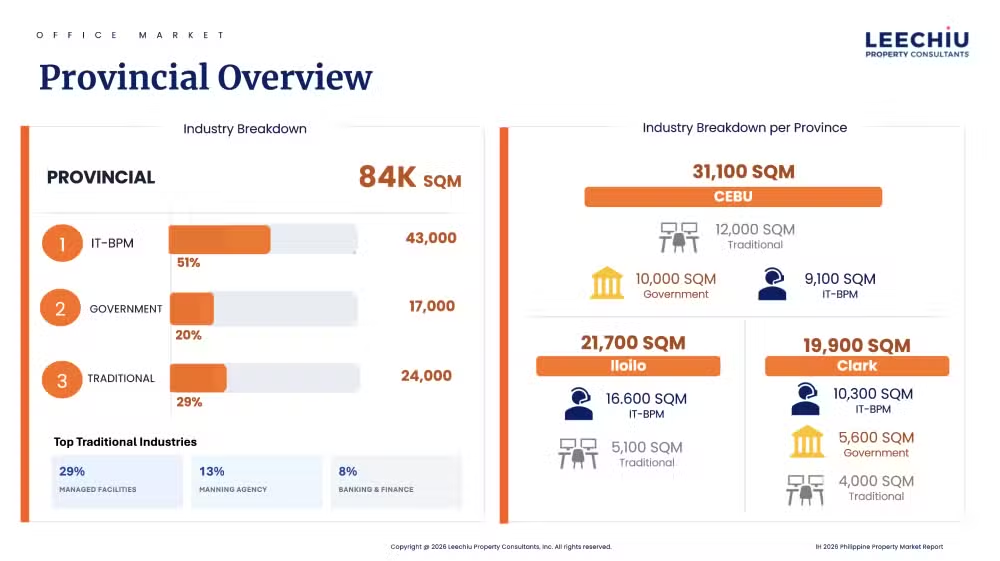
In H1 2026, provincial markets accounted for only 17 percent of national office take-up, roughly 84,000 sqm, or just 53 percent of H1 2025 levels, largely due to a pullback in IT and business process management (IT-BPM) activity outside Metro Manila.
That’s a headwind, but it is more reason to be selective than to write off CamSur Uptown.
Established hubs are still absorbing space, albeit more slowly. Cebu posted 31,100 sqm of first-half take-up; Iloilo 21,700 sqm; And Clark 19,900 sqm, with Cebu set to add 174,000 sqm of new supply over the next three years.
Built-in Peza eligibility
CamSur Uptown isn’t walking into an empty field, either.
Global capability centers remain the single largest source of live requirements, accounting for 88,000 sqm of the national 353,000 sqm active pipeline, ahead of the 67,000 sqm attributed to third-party outsourcers.
CamSur Uptown offers built-in Peza eligibility, modern infrastructure and contiguous scale that older provincial parks and congested Metro Manila hubs may struggle to provide.
Large occupiers often struggle to find Peza-accredited buildings with substantial contiguous space in Metro Manila. Bonifacio Global City (BGC), the most preferred address for large requirements, has only five qualifying buildings offering a combined 43,000 sqm of available space to meet such demand.
In our view, that scarcity is exactly the kind of constraint that, over time, strengthens the case for provincial markets among occupiers that need scale.
The bigger picture
CamSur Uptown belongs in the same conversation as the broader shift toward infrastructure-supported corridors outside the core markets, following the same logic behind expansion into Cavite, Laguna, Bulacan, Pampanga and the Clark-Subic-Manila-Batangas corridor.
Bicol currently lacks that critical mass, but an airport undergoing expansion, a functioning highway network and a provincial government locating its own capitol within the estate are promising building blocks.
It also helps that CamSur Uptown is not creating demand from scratch. The cities of Naga and Legazpi already host pockets of BPO locators, and the ambition is to build on that existing activity and consolidate it within one master-planned estate.
On talent, universities such as Ateneo de Naga and the Central Bicol State University of Agriculture (CBSUA) provide a steady pool of graduates, while lower labor costs could further strengthen the region’s appeal to occupiers.
Our honest read
CamSur Uptown is a long-term play, not one that will show up in next year’s numbers.
Success hinges on execution: Whether the digital campus and PEZA zones attract anchor tenants and whether Tier 2 Next Wave City status becomes a reality.
The local government of Camarines Sur has a chance to get this right. What works in its favor is the scale of the opportunity: India has over 2,000 global capability centers, while the Philippines has only around 200. That gap points to the long-term growth opportunity CamSur Uptown can tap into.
For those thinking five to 10 years ahead about the next business district in South Luzon, this one is worth putting on the radar now, especially for those looking to position early.
The article was originally published in Inquirer.Net and written by Edward Gador.
If you like this article, share it on social media by clicking any of the icons below.
About Post Author



More Stories
SCTEx expansion to boost Central Luzon growth
NCR construction materials wholesale price growth hits 3-year high in August
High-value manufacturers drive industrial property expansion